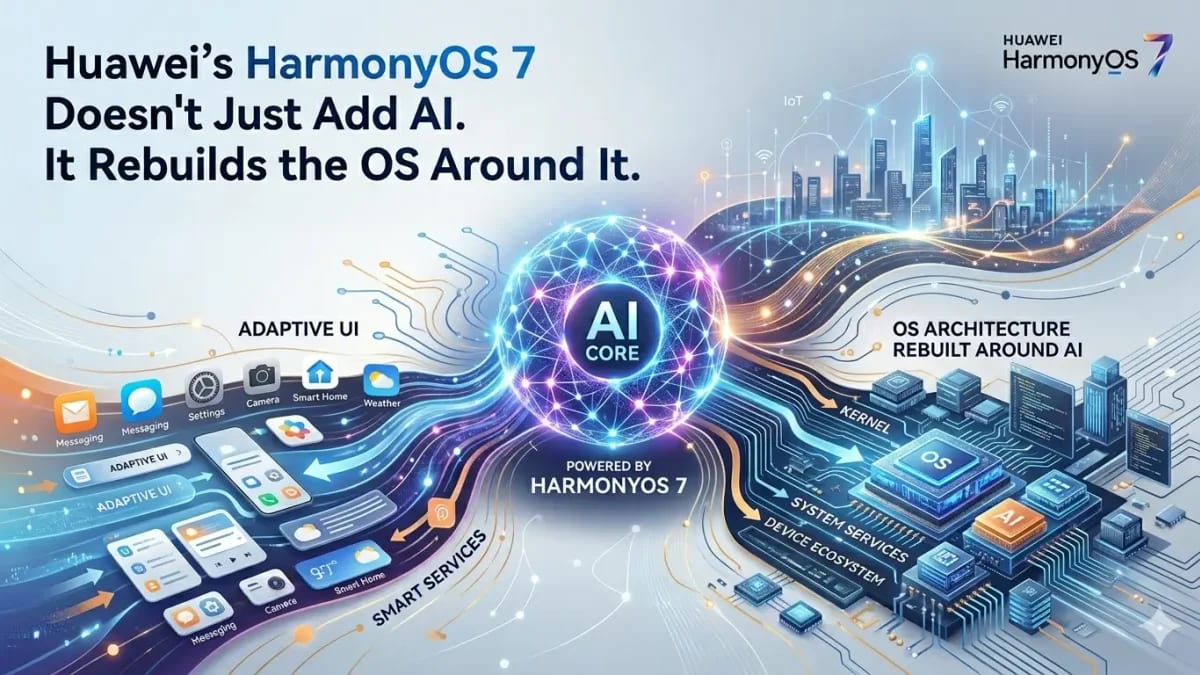
Huawei's HarmonyOS 7 Doesn't Just Add AI. It Rebuilds the OS Around It.
Huawei unveiled HarmonyOS 7 at HDC 2026 with an Agent Framework 2.0 that connects to 2,000+ specialized AI agents and a task execution rate above 90%. This isn't a feature update. It's a platform identity change.
 Nick Bunker
Here is the sentence Huawei wants you to take away from HDC 2026: the app era is over. Here is the sentence that actually matters: Huawei has built an operating system that can read your screen, understand your intent, and act on it — across 2,000 specialized agents — without you opening a single app.
HarmonyOS 7, unveiled Friday at Huawei's annual developer conference in Dongguan, is not an incremental update to a mobile operating system. It is a declaration about what a mobile operating system is supposed to be. Richard Yu Chengdong, chairman of Huawei's Consumer Business Group, narrated the evolution in three sentences: "In 2019, HarmonyOS was born. In 2023, native HarmonyOS apps began. In 2026, HarmonyOS enters the Agent era." That timeline is doing real work. Each line corresponds to a complete identity change, not a version number.
The mechanism behind the Agent era is the HarmonyOS Intelligent Agent Framework 2.0. It introduces three capabilities that, taken individually, are incremental. Taken together, they constitute a different theory of what software should do. The first is intent-as-a-service: the system parses what a user is trying to accomplish rather than which app they want to open. The second is GUI-level control — the framework can read on-screen information and simulate taps across any application, with or without that app's cooperation. The third is task decomposition: complex, multi-step requests are broken into sequences the system executes autonomously, with Huawei claiming a task completion rate above 90 percent.
The 2,000-Agent Number Deserves Scrutiny
Huawei's headline figure — connection to more than 2,000 specialized AI agents — is the kind of number that sounds large until you ask what it means in practice. The demonstration cases presented at HDC 2026 are instructive: the system generating a personalized marathon training plan from health data and calendar schedules; locating and transmitting a file from a connected laptop without manual navigation. These are coherent, useful tasks. They are also tasks that require a user's data to be legible to the system at a level most Western consumers have not yet accepted as standard.
That friction does not exist in the same form in HarmonyOS's primary market. China's regulatory environment, user expectations around data integration, and Huawei's deep vertical integration — the company makes the chips, the devices, and now the agent infrastructure — create conditions where 2,000 connected agents is a feasible architecture rather than a hypothetical. Whether that architecture exports cleanly is a different question.
The Glass Everyone Is Wearing This Year
Strip away the agent story and HarmonyOS 7 has a second headline: it looks like iOS 26. The Liquid Glass aesthetic — translucent surfaces, frosted system elements, 3D depth effects on the lock screen — arrived on Apple's platform three days before HDC 2026. Samsung's One UI 9 is in beta with the same visual language. Huawei is now the third major OS to commit to it in a single week.
This is not plagiarism. It is convergence, and convergence at this speed tells you something about how the design decision was made. All three companies arrived at translucency and depth simultaneously because all three are responding to the same underlying hardware shift: screens capable of rendering depth effects without meaningful performance cost. The aesthetic follows the silicon. Huawei's implementation covers system UI elements like sliders and buttons, the lock screen with 3D depth effects, and notification surfaces — with the 3D scene conversion on the lock screen being the most distinctive execution of the trend.
What the Numbers Say
HarmonyOS 7 delivers a 15% performance improvement over HarmonyOS 6.1. The HarmonyOS ecosystem has reached 66 million devices running HarmonyOS 6, with over 11 million registered developers and more than 400,000 available applications and services. Huawei's stated target is 100 million devices. The developer beta launched Friday; stable consumer release is scheduled for fall 2026, timed — almost certainly deliberately — to coincide with Huawei's next flagship hardware announcement.
The update comes just days after Apple unveiled a major overhaul of Siri in iOS 27 — meaning both companies chose the same two-week window to redefine what their AI assistants can do. That timing is not a coincidence. It is competitive positioning, and it tells you that the race to own the AI layer of the mobile operating system is no longer theoretical. It is happening now, and it is happening fast.
The thermometer is not just moving. It has reached temperature.
More to read
All articles →
SpaceX Just Bought the Coding Tool Half of Silicon Valley Depends On
Four days after the largest IPO in history, SpaceX exercised its option to acquire AI startup Corsair for $60 billion in stock. This deal gives Elon Musk's xAI division a million paying developers overnight.